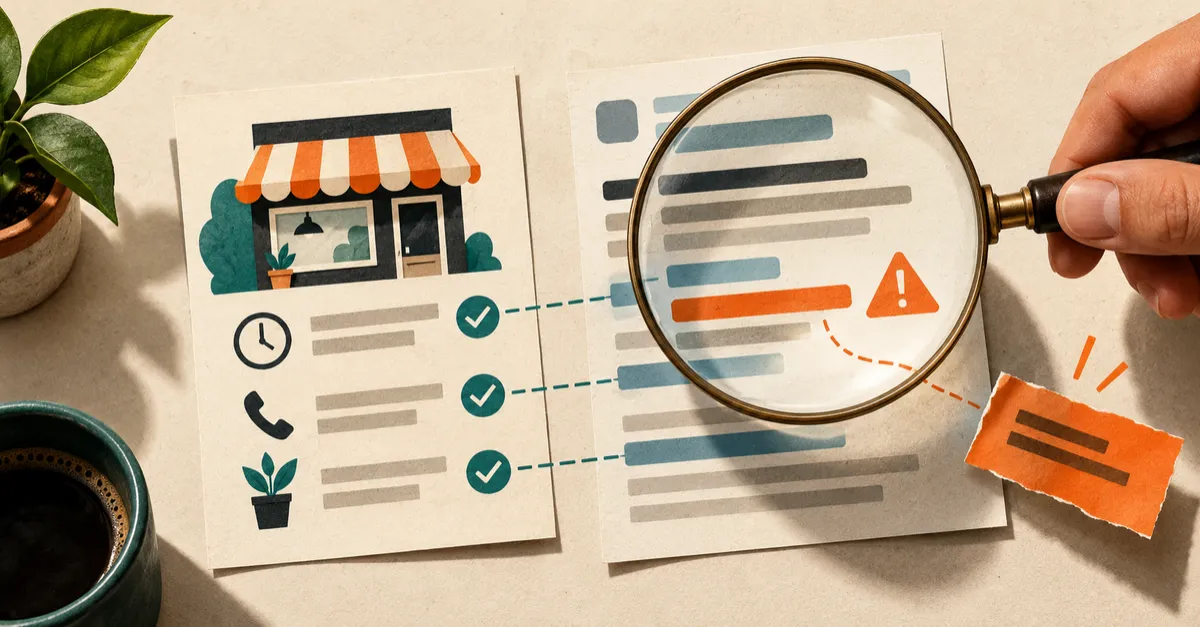
AI Hallucinations: Check What AI Says About Your Business
Ask an AI about your business and it may give a beautifully written answer. The address could be wrong. The refund policy could be invented. The service it recommends might be something you have never offered.
Good writing is not a fact check.
The 15-second answer
An AI hallucination is an unsupported or incorrect output presented as if it were true. Check company answers against an approved fact sheet and open every important citation. Asking for sources or telling AI not to invent can help structure the task, but neither guarantees accuracy. This issue provides an audit; it does not claim we tested your company or observed a particular failure rate.
WHAT happened?
March 2026 coverage of Anthropic's large interview study put AI unreliability back in the spotlight. In the primary study, 26.7% of respondents expressed concerns classified as unreliability, including inaccurate answers and fake citations. Participants were Claude users, and concerns could overlap. This is not a measured AI error rate or a representative SMB survey. [1][2]
For an owner, the actionable question is what customers might be told about your business.
WHO should give a shit?
Businesses with changing hours, complex service areas, multiple locations, pricing conditions or important eligibility rules. Also anyone using AI to draft website copy or customer responses.
A false “yes, they offer emergency service” can create a disappointed customer even if everything else in the answer is correct.
WHY does this matter to your business?
AI answers may blend accurate information, old information and plausible guesses. An invented discount is especially believable when it appears beside your real address.
Give staff a source of truth: the approved business name, address, hours, service area, services, exclusions, pricing rules and contact details. Add a reviewed date and an owner. That helps people verify drafts and gives you a checklist for public answers.
Do not confuse an inaccurate answer with proof of misconduct by the provider or proof that your site caused the mistake. First document what happened and which sources were used.
WHEN should you act?
NOW if AI-written copy reaches customers without review. Check public AI answers when you change important information and periodically after that.
WHERE would you look for mistakes?
Ask about opening hours, services, return rules, locations and prices. Ask one question whose correct answer is “we do not offer that.” Check the same questions in a tool with web access and, separately, a tool without it. Record the settings so you know what you are comparing.
An answer without access to current information should not be treated as a live directory.
HOW do you start Monday morning?
Build a one-page fact sheet from your current approved records. Ask ten questions, save the complete answers and date each run. Classify every factual statement as supported, outdated, wrong or unverifiable.
Open citations and confirm that the cited page actually supports the statement. A real webpage attached to an unrelated claim is not evidence. Correct your website and business profiles where they are unclear or inconsistent, and use provider feedback options for documented errors. Rerun later; do not assume a correction propagates everywhere immediately.
For internal drafting, try: “Use only the facts below. Mark missing information as unknown. Do not invent services, prices or policies.” Then check the result against the same facts.
The Bullshit Meter
Hype 6/10 | SMB usefulness 9/10 | Risk 7/10 | Verdict CHECK NOW. Editorial judgment about unchecked customer-facing facts. Confidence is a tone, not evidence.
Don't Put This Into AI
Do not upload private client files to prove a public business fact. Public hours, service descriptions and approved policy pages should be enough.
Questions owners actually ask
Can a better prompt stop hallucinations?
It can reduce ambiguity and request unknowns, but important facts still require verification.
How do I check a citation?
Open it, locate the relevant passage and confirm that it supports the exact claim, date and business entity.
What if AI invents a service I do not offer?
Document the answer, clarify public service information and report the specific error through available feedback channels.
This week's move: ask five questions about your company, including one service you do not offer.
Sources
[1] Anthropic What 81000 people want from AI with March 22 2026 Financial Times coverage
[2] Financial Times AI hallucinations haunt users more than job losses March 22 2026